smartquote元素自始可用
A language-aware quote that reacts to its context.
Automatically turns into an appropriate opening or closing quote based on the active text language.
Example
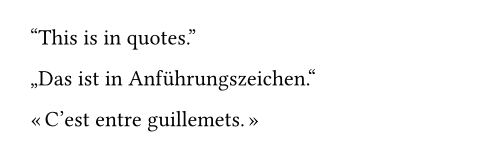
"This is in quotes."
#set text(lang: "de")
"Das ist in Anführungszeichen."
#set text(lang: "fr")
"C'est entre guillemets."
Syntax
This function also has dedicated syntax: The normal quote characters (' and "). Typst automatically makes your quotes smart.
参数
double默认值:true
Whether this should be a double quote.
enabled默认值:true
Whether smart quotes are enabled.
To disable smartness for a single quote, you can also escape it with a backslash.
 展开示例
展开示例
#set smartquote(enabled: false)
These are "dumb" quotes.

alternative默认值:false
Whether to use alternative quotes.
Does nothing for languages that don’t have alternative quotes, or if explicit quotes were set.
展开示例
#set text(lang: "de")
#set smartquote(alternative: true)
"Das ist in anderen Anführungszeichen."

quotes默认值:auto
The quotes to use.
- When set to
auto, the appropriate single quotes for the text language will be used. This is the default. Custom quotes can be passed as a string, array, or dictionary of either
- string: a string consisting of two characters containing the opening and closing double quotes (characters here refer to Unicode grapheme clusters)
- array: an array containing the opening and closing double quotes
- dictionary: a dictionary containing the double and single quotes, each specified as either
auto, string, or array
展开示例
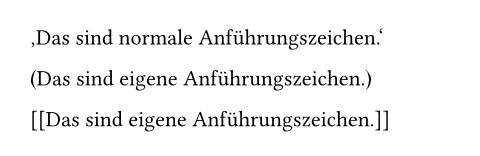
#set text(lang: "de")
'Das sind normale Anführungszeichen.'
#set smartquote(quotes: "()")
"Das sind eigene Anführungszeichen."
#set smartquote(quotes: (single: ("[[", "]]"), double: auto))
'Das sind eigene Anführungszeichen.'