
bytes0.7.0起可用
A sequence of bytes.
This is conceptually similar to an array of integers between 0 and 255, but represented much more efficiently. You can iterate over it using a for loop.
You can convert
- a string or an array of integers to bytes with the
bytesconstructor - bytes to a string with the
strconstructor, with UTF-8 encoding - bytes to an array of integers with the
arrayconstructor
When reading data from a file, you can decide whether to load it as a string or as raw bytes.
#bytes((123, 160, 22, 0)) \
#bytes("Hello 😃")
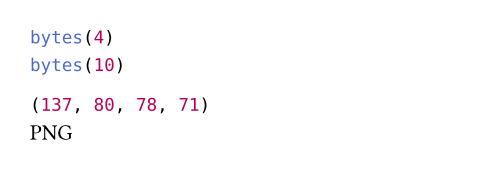
#let data = read(
"rhino.png",
encoding: none,
)
// Magic bytes.
#array(data.slice(0, 4)) \
#str(data.slice(1, 4))
构造函数0.7.0起可用
Converts a value to bytes.
- Strings are encoded in UTF-8.
- Arrays of integers between
0and255are converted directly. The dedicated byte representation is much more efficient than the array representation and thus typically used for large byte buffers (e.g. image data).
 展开示例
展开示例
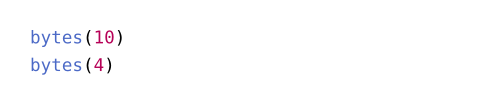
#bytes("Hello 😃") \
#bytes((123, 160, 22, 0))
value
The value that should be converted to bytes.
定义
len0.7.0起可用
The length in bytes.
at0.7.0起可用
Returns the byte at the specified index. Returns the default value if the index is out of bounds or fails with an error if no default value was specified.
index
The index at which to retrieve the byte.
defaultany
A default value to return if the index is out of bounds.
slice0.7.0起可用
Extracts a subslice of the bytes. Fails with an error if the start or end index is out of bounds.
start
The start index (inclusive).
end默认值:none
The end index (exclusive). If omitted, the whole slice until the end is extracted.
count
The number of items to extract. This is equivalent to passing start + count as the end position. Mutually exclusive with end.