
float自始可用
A floating-point number.
A limited-precision representation of a real number. Typst uses 64 bits to store floats. Wherever a float is expected, you can also pass an integer.
You can convert a value to a float with this type’s constructor.
NaN and positive infinity are available as float.nan and float.inf respectively.
Example
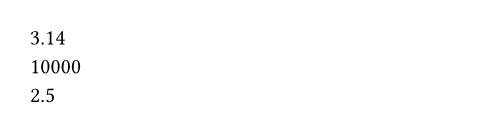
#3.14 \
#1e4 \
#(10 / 4)
构造函数自始可用
Converts a value to a float.
- Booleans are converted to
0.0or1.0. - Integers are converted to the closest 64-bit float. For integers with absolute value less than
calc.pow(2, 53), this conversion is exact. - Ratios are divided by 100%.
- Strings are parsed in base 10 to the closest 64-bit float. Exponential notation is supported.
 展开示例
展开示例
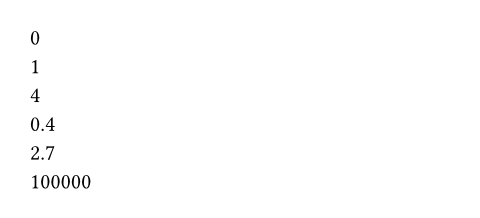
#float(false) \
#float(true) \
#float(4) \
#float(40%) \
#float("2.7") \
#float("1e5")
value
The value that should be converted to a float.
定义
is-nan0.11.0起可用
Checks if a float is not a number.
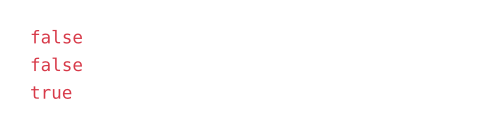
In IEEE 754, more than one bit pattern represents a NaN. This function returns true if the float is any of those bit patterns.
展开示例
#float.is-nan(0) \
#float.is-nan(1) \
#float.is-nan(float.nan)
is-infinite0.11.0起可用
Checks if a float is infinite.
Floats can represent positive infinity and negative infinity. This function returns true if the float is an infinity.
展开示例
#float.is-infinite(0) \
#float.is-infinite(1) \
#float.is-infinite(float.inf)
signum0.11.0起可用
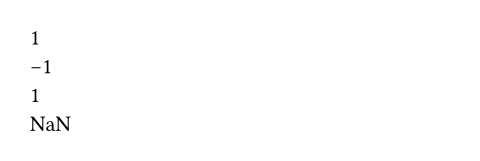
Calculates the sign of a floating point number.
- If the number is positive (including
+0.0), returns1.0. - If the number is negative (including
-0.0), returns-1.0. - If the number is NaN, returns
float.nan.
展开示例
#(5.0).signum() \
#(-5.0).signum() \
#(0.0).signum() \
#float.nan.signum()
from-bytes0.12.0起可用
Interprets bytes as a float.
展开示例
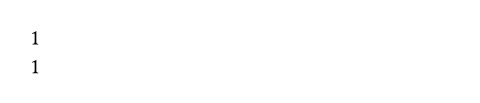
#float.from-bytes(bytes((0, 0, 0, 0, 0, 0, 240, 63))) \
#float.from-bytes(bytes((63, 240, 0, 0, 0, 0, 0, 0)), endian: "big")
bytes
The bytes that should be converted to a float.
Must have a length of either 4 or 8. The bytes are then interpreted in IEEE 754′s binary32 (single-precision) or binary64 (double-precision) format depending on the length of the bytes.
endian默认值:"little"
The endianness of the conversion.
| Variant | Details |
|---|---|
"big" | Big-endian byte order: The highest-value byte is at the beginning of the bytes. |
"little" | Little-endian byte order: The lowest-value byte is at the beginning of the bytes. |
to-bytes0.12.0起可用
Converts a float to bytes.
展开示例
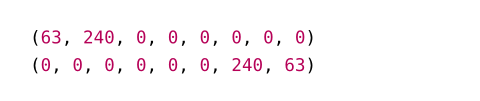
#array(1.0.to-bytes(endian: "big")) \
#array(1.0.to-bytes())
endian默认值:"little"
The endianness of the conversion.
| Variant | Details |
|---|---|
"big" | Big-endian byte order: The highest-value byte is at the beginning of the bytes. |
"little" | Little-endian byte order: The lowest-value byte is at the beginning of the bytes. |
size默认值:8
The size of the resulting bytes.
This must be either 4 or 8. The call will return the representation of this float in either IEEE 754′s binary32 (single-precision) or binary64 (double-precision) format depending on the provided size.